
Let there be cake

Meet chef Oleg Bibikov and his charity food truck team as they bake over a thousand Christmas cakes for displaced people in the eastern Ukrainian city of Sumy.
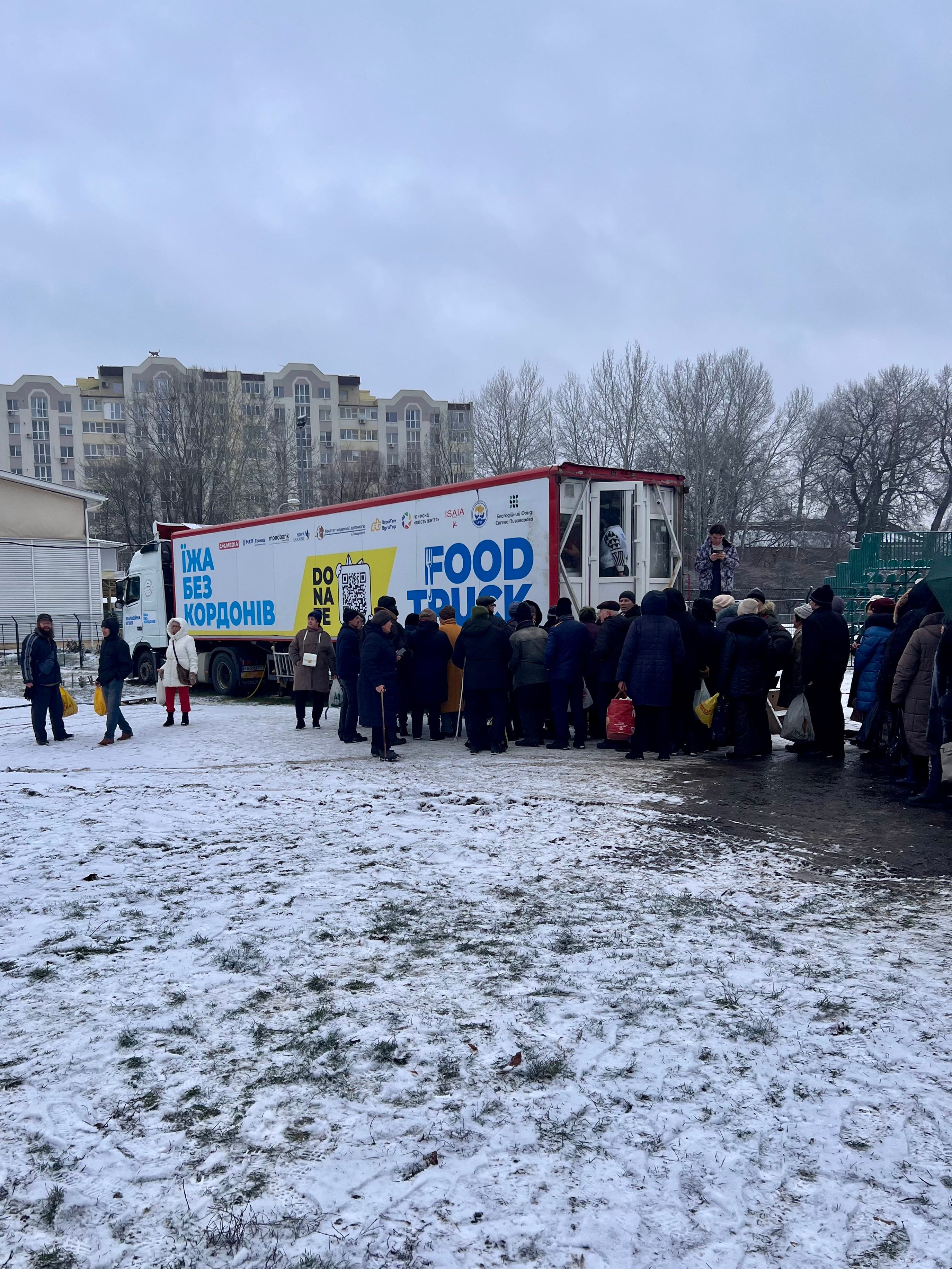
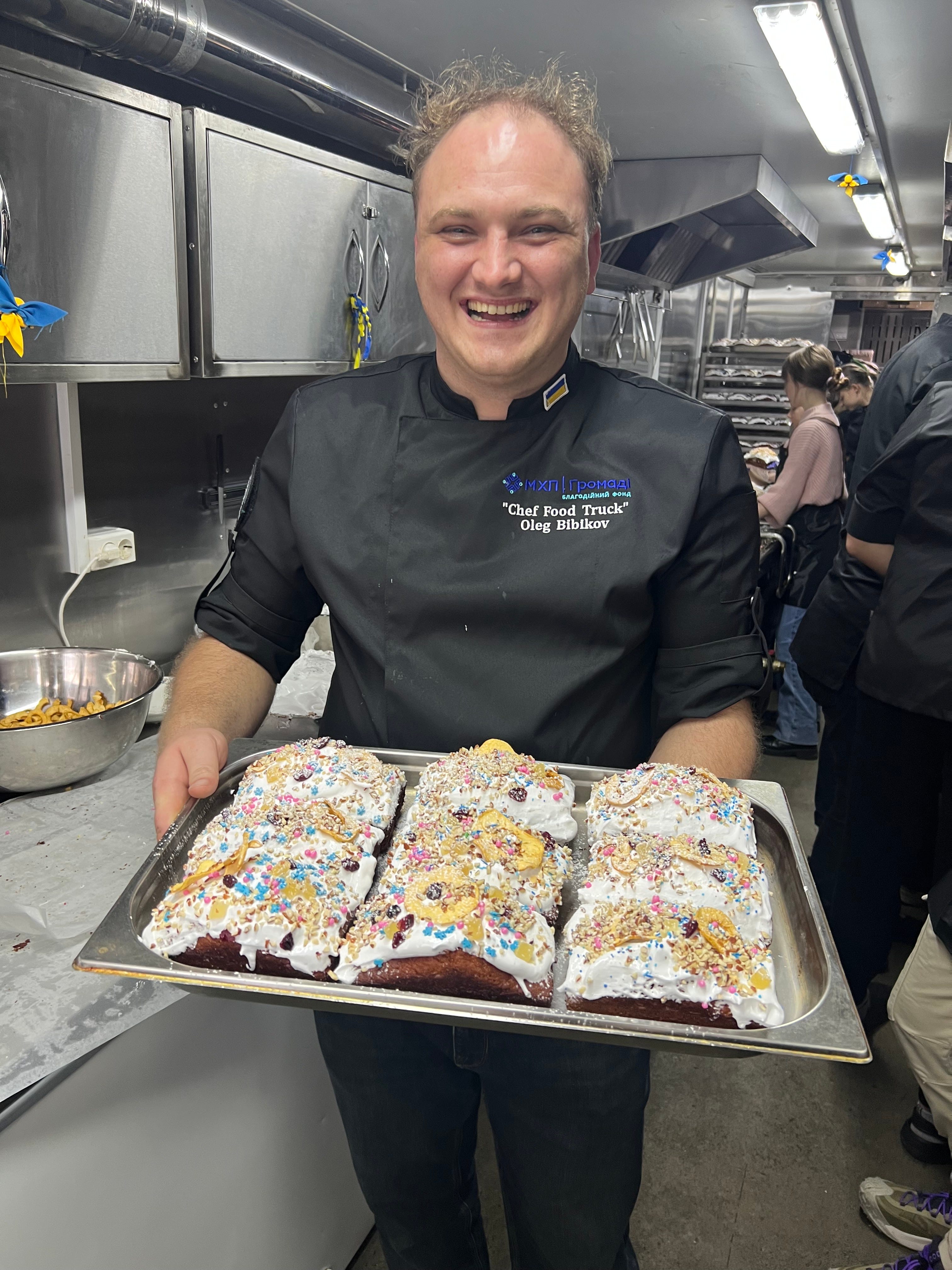
In a snow covered park in the centre of Sumy in eastern Ukraine, there was the sound of Christmas music coming from a large lorry painted with the slogan ‘Food Truck’ along the side. Inside, chef Oleg Bibikov and his small team of cooks and helpers from his Iskra Dobra charity were busy baking more than a thousand Christmas cakes and decorating them with Swiss meringue frosting and brightly coloured sugar, to give away to local elderly people and families displaced by the fighting near the border, just a few miles away.
Oleg and his young chefs had driven through the night to get here from Chernihiv, where he has a restaurant and bakery: the road is not particularly safe, but luckily they had arrived in one piece, although Oleg was especially pleased when I presented him with a tin of Fortnums coffee, making himself a large mug straight away.
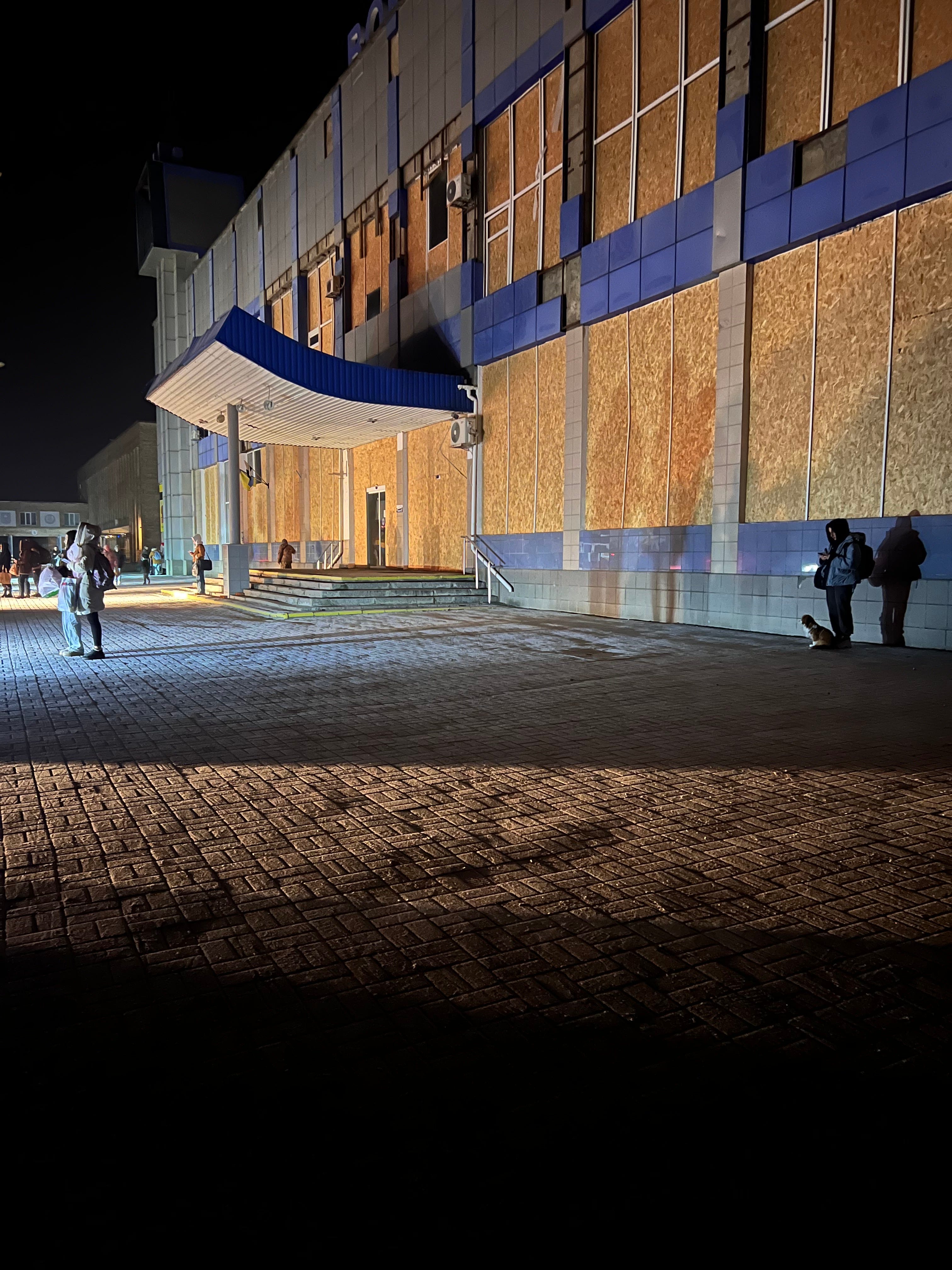
I had arrived in Sumy in the early hours on the night train from Kyiv, which also passes close to the Russian border. Sumy’s railway station was shelled by the Russians at the end of October, and the entire front was still boarded up. It was freezing cold, and I thought a taxi might be impossible to find, but one eventually turned up after around half an hour, and we drove through the darkness to my friend’s apartment block for a couple more hours sleep.
On the way to Oleg’s food truck, we stopped at the excellent Espresso Room coffee shop in the city centre, for some much needed coffee and plates of savoury syrniki with smoked salmon and salad - the ideal breakfast before a day in the food truck.
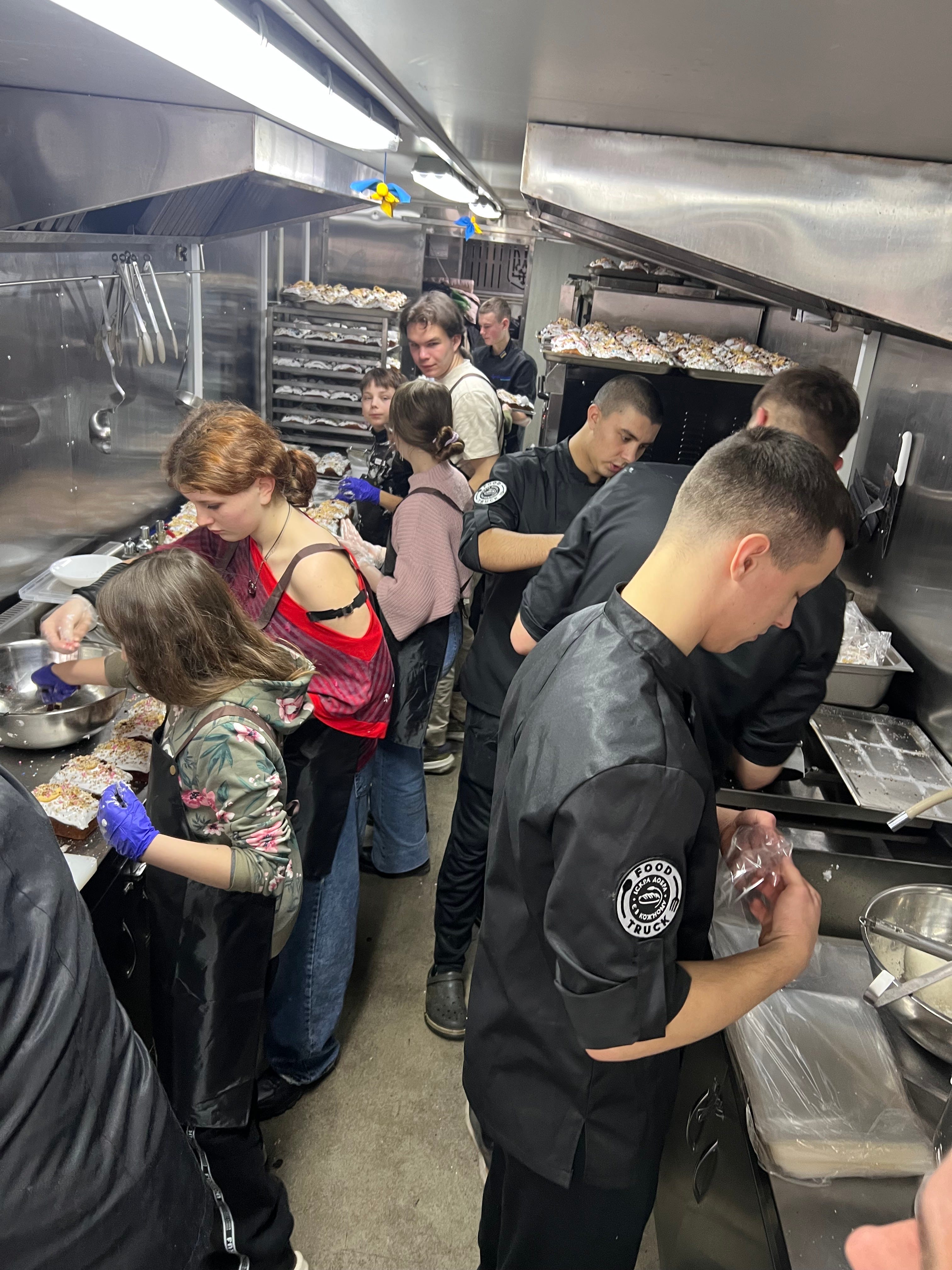
We heard Oleg’s truck before we spotted it, tucked away in a small clearing in the park, pumping out festive tunes. He threw open the back doors to welcome us inside, the windows fugged up with steam coming from the oven, trays of loaf cakes cooling down on racks lining the walls. There seemed to be an impossibly large number of people inside, happily pulling cakes from the oven, whipping up clouds of glossy meringue, sprinkling hundreds and thousands around. Three young chefs had joined Oleg from his Chernihiv restaurant, along with a couple of local Sumy staff. There was me, my Ukrainian friend Viktoria and translator Anastasia. Four schoolchildren arrived to help with the decorating. Oleg seized one of the cakes, still warm, and broke it up into pieces for everyone to try. “We make cakes for the people here that are the quality we would really want to eat ourselves”, he said, offering me a piece of the buttery vanilla sponge, studded with plump raisins.
He switched the radio to some Hebrew songs for Hanukkah, inviting me to sing along with the Hava Nagila - with all the Jewish wedding party vibes. Outside, a queue was already forming of people patiently waiting for their cakes, and as soon as the decorations were dry, the team began packing them neatly into cellophane bags. Oleg and his young sous-chef Igor ferried crates of them out to the trestle table, keen to avoid making people stand around for too long in the cold.
The day passed in a blur of festive music, the mixer whipping up bowl after bowl of frosting, the children scattering sprinkles like glittery jewels, trays cooling down on the worktops, the residents outside breaking into smiles as they left, clutching their packets of cakes. Truth be told, I am sure I got in the way rather more than helping, but nobody minded. Once the final cake had been dispatched, and the boys were clearing down, we took a few group photos to remember the day and Oleg and crew set off for the long drive back north to Chernihiv.
Anastasia and I headed back into town in search of something to eat, wandering through the dark streets slightly aimlessly before ending up in a Ukrainian place with a menu offering ‘Big pan for two strong Ukrainian men’ and a ‘crazy meat trough’. Sensibly we chose some cabbage and beetroot salads, and cherry varenyky dumplings with sour cream for dessert. Sumy is a beautiful city, but the fighting along the border region is close enough to hear the distant sounds of explosions, while the city itself is often targeted by drone and guided bomb attacks.
The following morning I had been invited to interview the deputy head of the regional military administration, Volodymyr Babych, who was a member of one of the voluntary combat units which defended the city in 2022. He talked about the continuing efforts to evacuate people from border areas, and what resources were available for them when they arrived in the city. The figures were overwhelming: more than 3,800 buildings in the region badly damaged or destroyed, while tens of thousands of people have been relocated - including families with children. Work was still going on to cover hundreds of miles of roads with anti drone netting, while rerouting public transport away from the most dangerous routes. On the positive side, Mr Babych was keen to talk about efforts to help military veterans to set up small businesses and find new work after their army service, with the support of international donors - so they can become active participants in the city’s economy again. While I also saw that the UNHCR has begun working with the authority to build modular homes for displaced people as part of its ‘Living Space’ project.
Our talk went on so long that we were afraid of missing the ‘mashrutka’ bus service back to Kharkiv, although the taxi driver drove extra fast, promising that he could get us there in time. We had some extra luggage to carry back: an iced cake each from Oleg’s food truck and a large box containing cookies, gingerbread and a stollen from his bakery in Chernihiv.
The embattled Sumy region came under twice as many Russian attacks in 2025 as the year before - with many hundreds of lives lost or forever changed. But acts of generosity and resilience like Oleg’s Food Truck, bring some light and hope to this hero city in eastern Ukraine.
Beautiful and uplifting. Thank you for sharing❤️